Sodomic Archiving
by Michiel Teeuw, 2026
Some access notes before we start:
- image description of myself
- read along + translate on www.monsterarchief.net/blog
- any other access needs?
You don’t have to travel to Africa for monsters;
Europe breeds them in castles and palaces, full of disgrace!
- Joost van den Vondel
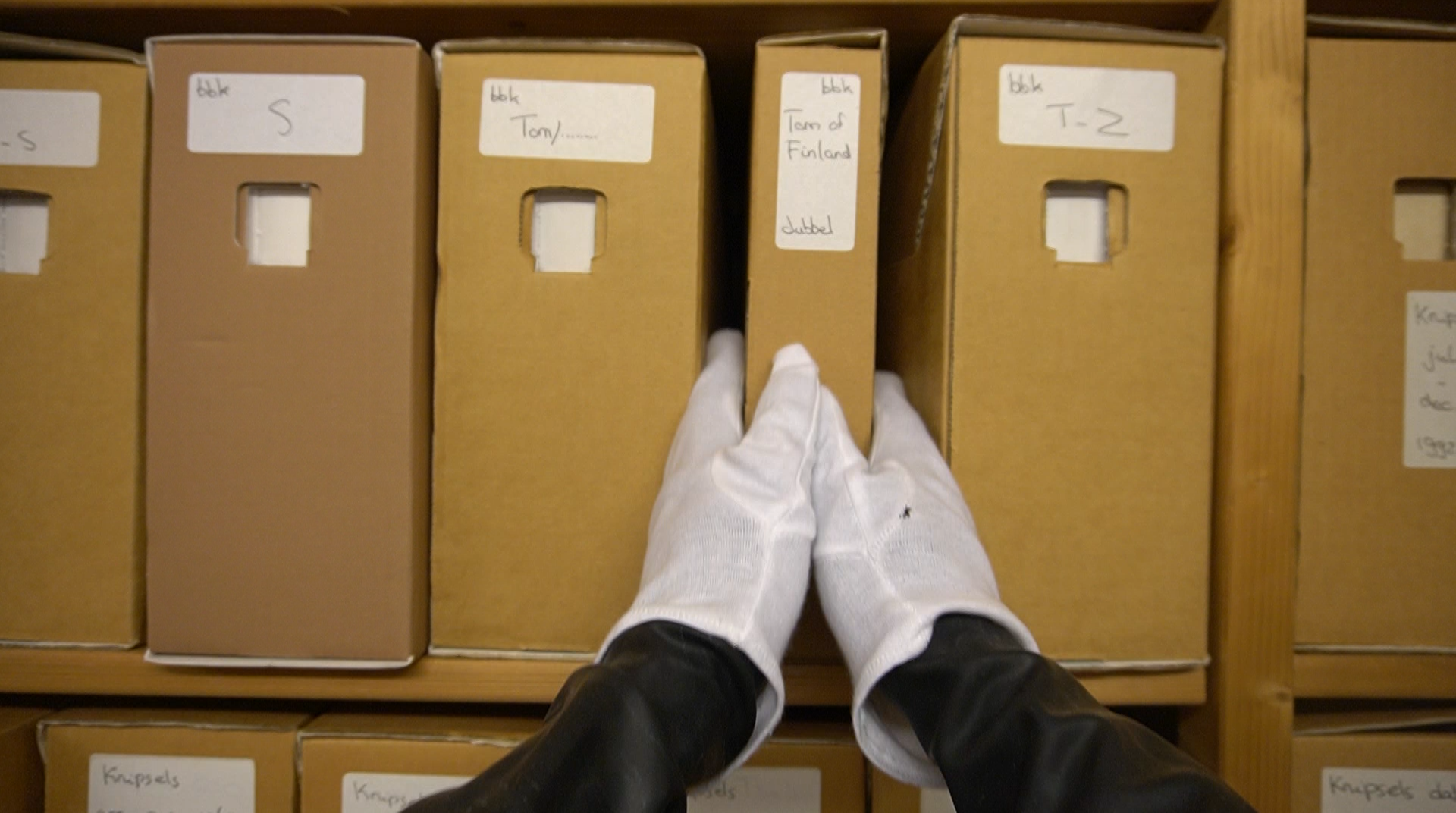
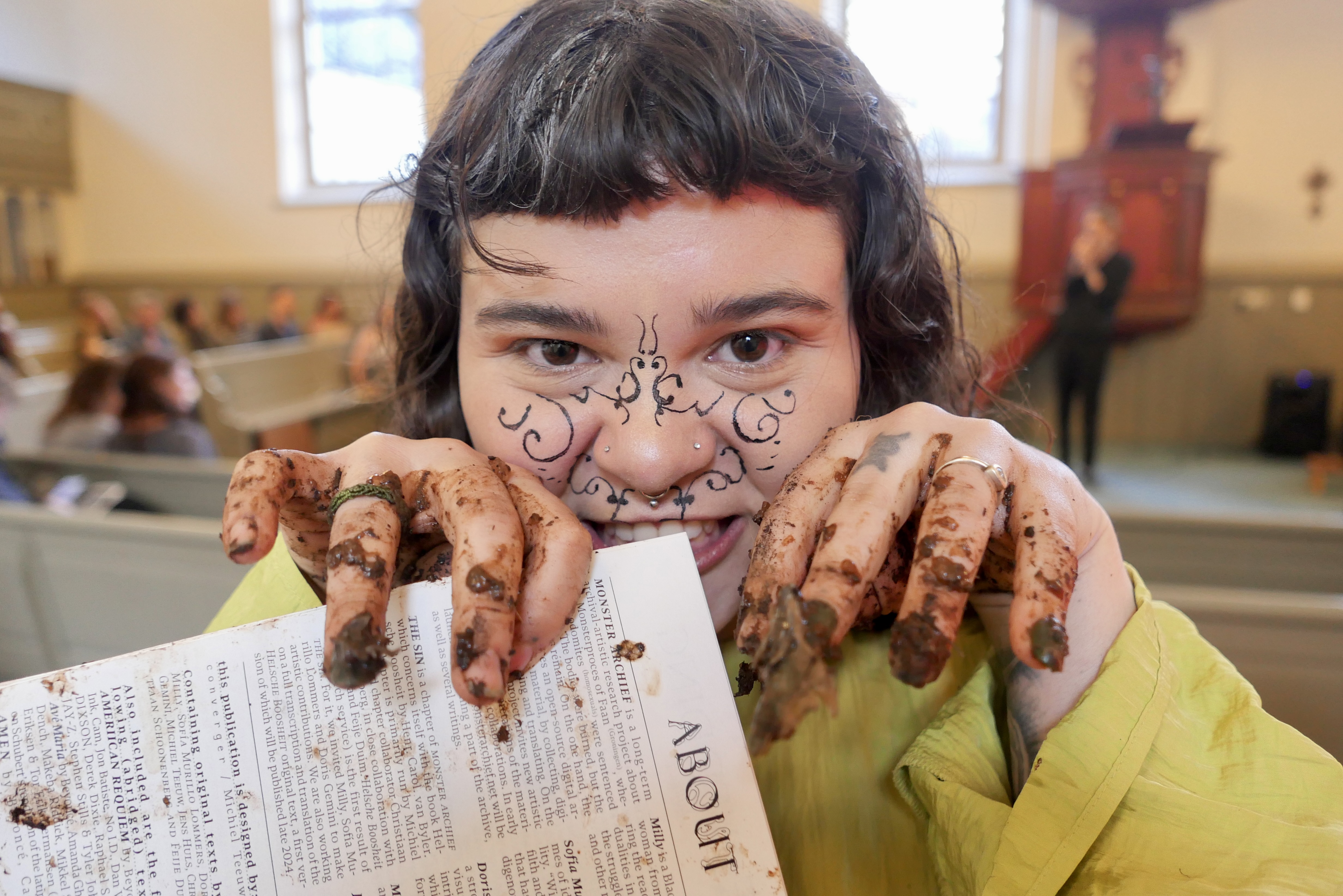
In 1731, in Zuidhorn, Groningen, Netherlands, 21(1) people were sentenced to death for practicing sodomy in the so-called Monsterproces of Faan. While sodomy prosecutions took place within the larger Dutch cities and colonies, this process is one of the largest cases in the rural (Northern) Netherlands and one of the largest mass executions in the history of the Netherlands. Their bodies were burned, their spirits were exiled into the atmosphere, but the materials remain ‒ such as legal transcripts, maps, archaeological findings, folk narratives, and religious pamphlets. The collective research project MONSTER ARCHIEF works on safekeeping and archiving the history of the Monsterproces. This is done both through the collection and digitalisation of artefacts from different heritage institutions, as well as the creation of new artistic works responding to the process. Together, they form an expanded archival practice which I’ve come to refer to as Sodomic Archiving. The project is organised and practiced in a network of (international) collaborators, including artists, archaeologists, theologians, legal scholars, historians and other (artistic) researchers. The project will run until 2031 and is present online at www.monsterarchief.net and @monsterarchief. In this presentation, I(2) will outline several strands of the Sodomic which I’ve developed over the years, as a continually developing modality of archival preservation and disruption.
Understanding Sodomy
I will start our journey by sketching out understandings of Sodomy in the Dutch context.
Sodomy as practice
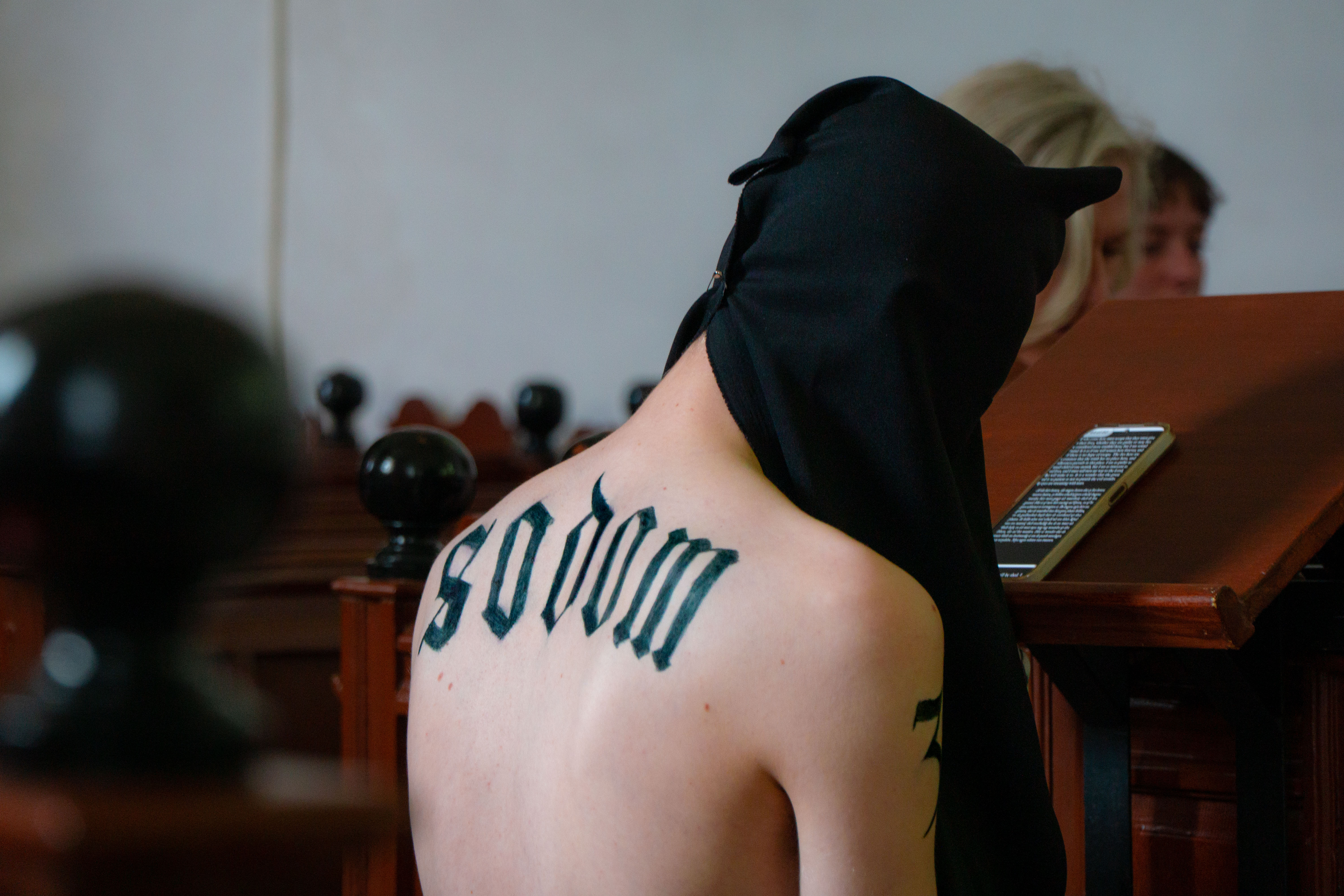
Theorist D. J. Noordam defines a sodomite as anyone who engages in homosexual acts or who indicates that they wish to engage in them, contrasting it with homosexuals, who are aware of their homosexuality or whose behavior indicates that they have a homosexual identity.(3) It is tempting to frame the Sodomy processes within the relatively stable, born-this-way, medical signifier of the homosexual - rooted in sexual nature - but such anachronistic renderings risk overriding intertemporal differences in the way we understand sex. This is why I started using the term people practicing sodomy rather than sodomites.
Sodomy as sinful, infectious and mute
Pastor Henricus Carolinus van Byler, who played a central role in the process, classically frames Sodomy as that abominable sin of which the inhabitants of Sodom (...) were guilty.(4) Especially when the nation-state is concerned, van Byler however operates a strange dual vocabulary of both sin and infection: the sins of Sodom have also infected and defiled our country.(5) Van Byler further lists different practices, such as ‘men’ having sex with ‘men’, ‘women’ not having sex with their ‘men’, ‘men or women’ having sex with ‘animals’ [bestiality], and ‘Christians’ having sex with ‘Jews’, and possibly ‘Heathens’ and ‘Turks’ [inter-religious and inter-racial sex]. Lastly, van Byler reproduces the notion of a Peccatum Mutum - a mute sin - as something which is not to be talked about. This invocation of muteness adds another layer to this unstable, clouded, near-ineffable and elusive concept.
One can elicitate an impression from this concept, however: Sodomy constituted any demonised sexual practice which destabilises current social categorisations and more broadly forms challenges to state power.
Sodomy as foreign
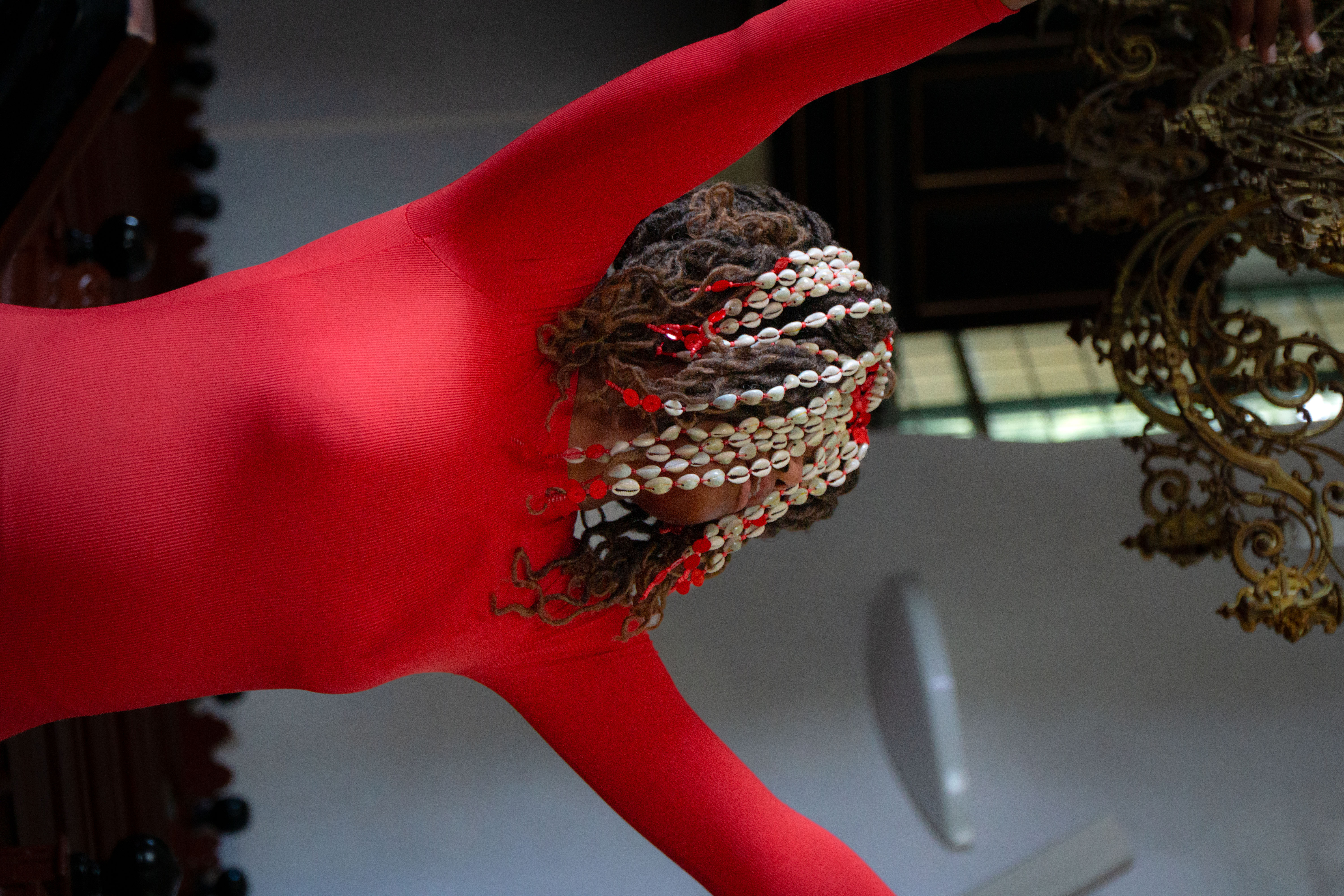
In 18th-century Groningen, Sodomy is often understood as a foreign sin. Van Byler is horrified by the thought that even the sins of Sodom have been brought over to our country from Italy and Turkey [an umbrella term for The East] as well.(6) Asia is pictured as full of cruel and savage people.(7) Van Byler further pontificates that [where] the Turks exercise their dominions, among them this accursed sin is also committed.(8) Sodomy is thus ideated as a practice carried by migrants across nation-states. Van Byler further describes Sodomy as this abomination, [which] has spread throughout the Netherlands like a cancer eating away at the body.(9) The ‘infestation’ of the Netherlands with Sodomy is then also rendered with great shock:
[W]ho could ever have imagined that people, living under such a great light of the blessed Gospel, and who have the laws of the great God, would give themselves over to such incomprehensible, hellish wickedness, and that it would be practiced so widely, and by all manner of people.(10)
For de Mepsche and others alike, the shock is even larger to find Sodomy in a small rural context, with a relatively low migrant presence:
I had never thought of this, and probably thought it impossible, in a village in the countryside, where simplicity is generally more commonly expected among the villagers, than in large places, where by an influx of all kinds of foreigners the vulgarities prevail more, and foreign sins are discovered.(11)
Those familiar with the workings of Orientalism immediately recognise the framing of Sodomy as an external threat, ascribed to the exoticised other, who operates in essential contradistinction to the White (Dutch) self.
Sodomy prosecution as xenophobia
Drawing on Proverbs 14:34, van Byler mentions that Sin is a stain of shame upon the nations,(12) thus applauding a German case of xenophobia:
The neighboring peoples fear that evil will spread from her country and that they will be infected by it. Consequently, the people of Hamburg have already, and rightly so, forbidden the refugees from staying there.(13)
Indeed, in the larger cities, there is a large number of migrants among those convicted for Sodomy. Noordam writes [about other Sodomy processes at the time]:
In and of itself, it is not surprising that there were many foreigners among the inhabitants of the major cities in the western Netherlands during the fifteenth and sixteenth centuries. These cities could only survive if people from outside the region continually settled there. But the examples given here concern men who did indeed come from very far away. Perhaps one can detect a certain xenophobia here; it is possible that these sodomites were outsiders.(14)
As outlined by researcher Jonas Roelens, sodomy prosecution and xenophobia are not only concomitant but deeply co-productive, since xenophobic sentiments and contemporary fears across borders framed and infused anxieties about sodomite conspiracies.(15) In recent decades, a White Homonationalist politics has erupted, reversing this orientalist projection onto the racialised other.(16) Suhaiymah Manzoor-Khan reflects on such movements by outlining how both Muslim and LGBTQ people are weaponised:
(...) as part of the orientalist myth, the 'Muslim world' was viewed as a site of homosexual activity. (...) European narratives about what makes Muslims outsiders have been constantly in flux. When racialising us as sexually deviant marked us as backwards, we were imagined as virulently homosexual; and now that homophobia is the mark of backwardness, we are ascribed with that. In either case, the treatment of Muslim and LGBTQ people shows we are actually irrelevant to Western states in their pursuit to define themselves in ways that obscure their violence.(17)
It is exactly this similar treatment which prompts me to posit sodomy prosecution as a subcategory of a broader Dutch 18th-century xenophobic politic.
%20-%20installation%20view%201%20-%20render%20by%20Siem%20de%20Boer.png)
Sodomic Archiving
Now that we have a basic understanding of Sodomy, I will dive into the concept of Sodomic Archiving.
Sodomic …
Sodomic is infectious and appearingly mute. It spreads; it turns people on; it sparks. It is something we concoct alone or together and bring to each other. We trade in dirty ideas and dirtier deeds. We do so under the radar, in signs, secret languages, broken signals and ineffable encounters. Sodomic is Xeno-Sodomic, realising that sexual liberation necessitates the absolvement of coloniality in all its forms. In theory, geography and positionality, it refuses the predominantly White Western scholarship which has captured Sodomy research for so long. Sodomic creates new global sexual politics. Sodomic refuses the xenophobically pathological Sodomy, the medical identitarian Homosexual and the no-longer-revolutionary Queer, as well its Dutch equivalent of Flikker. It rather delineates a set of sexual and cultural practices which form a direct threat to the nation-state. It is not rooted in community, belonging, or autobiography. It rather applies directly to practices, which carry real threat. I employ Sodomic from the vantage point of the crosshair, with a vested interest in sex that threatens, destabilizes or attacks colonial-capital statecraft and its economy. Adhering to this definition immediately opens up avenues of solidarity towards many interracial, crip, masturbatory, asexual, orgiastic, fetishistic, BDSM, interspecies, etc sexual practices which are in discordance with the nation-state’s material and ideological status quo. It simultaneously also allows for a more context-specific way of definition, directly responsive towards the contextual legalistic and systemic framework. That sex which threatens the powers that be, can be considered Sodomic.
Sodomic Archiving
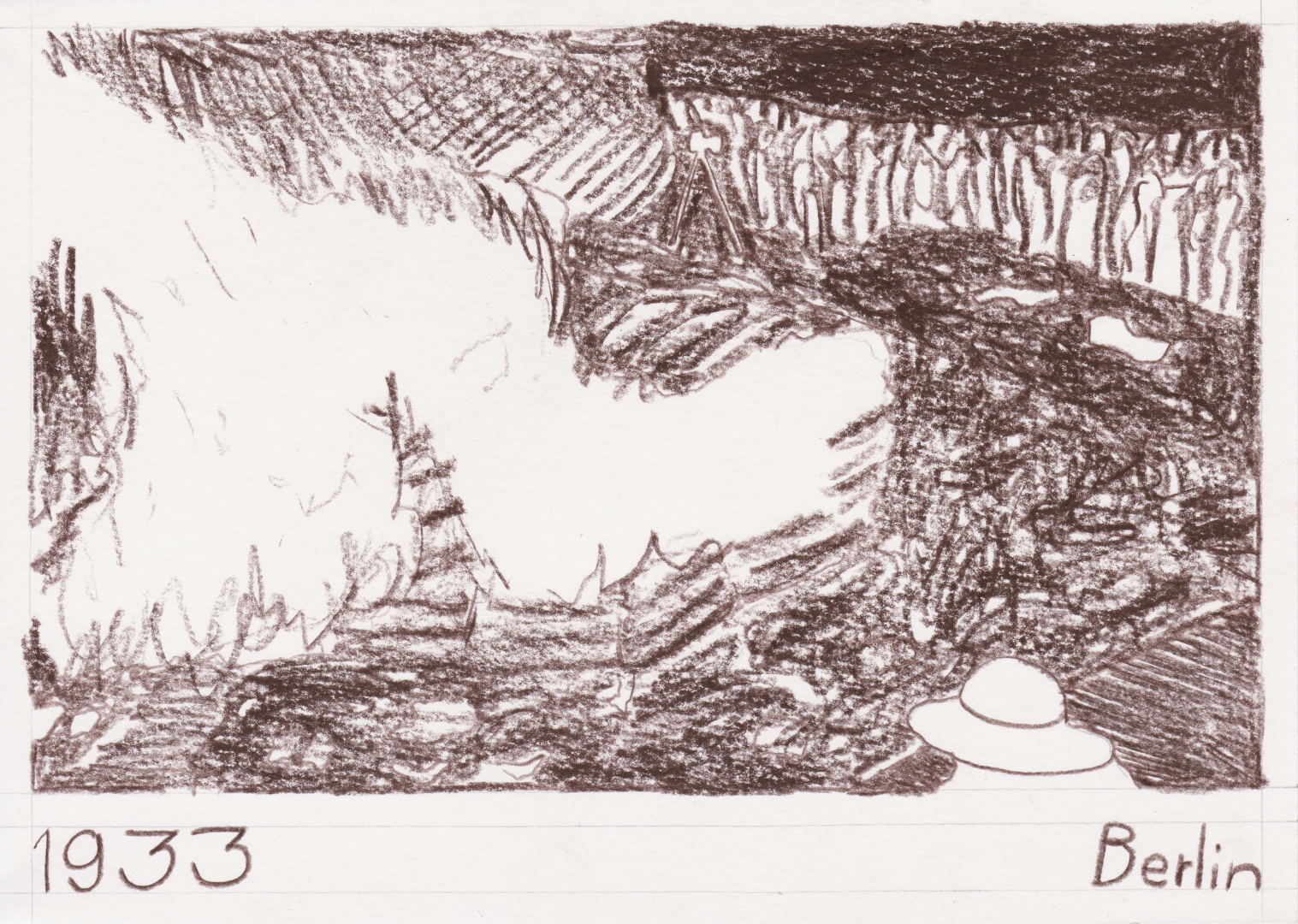
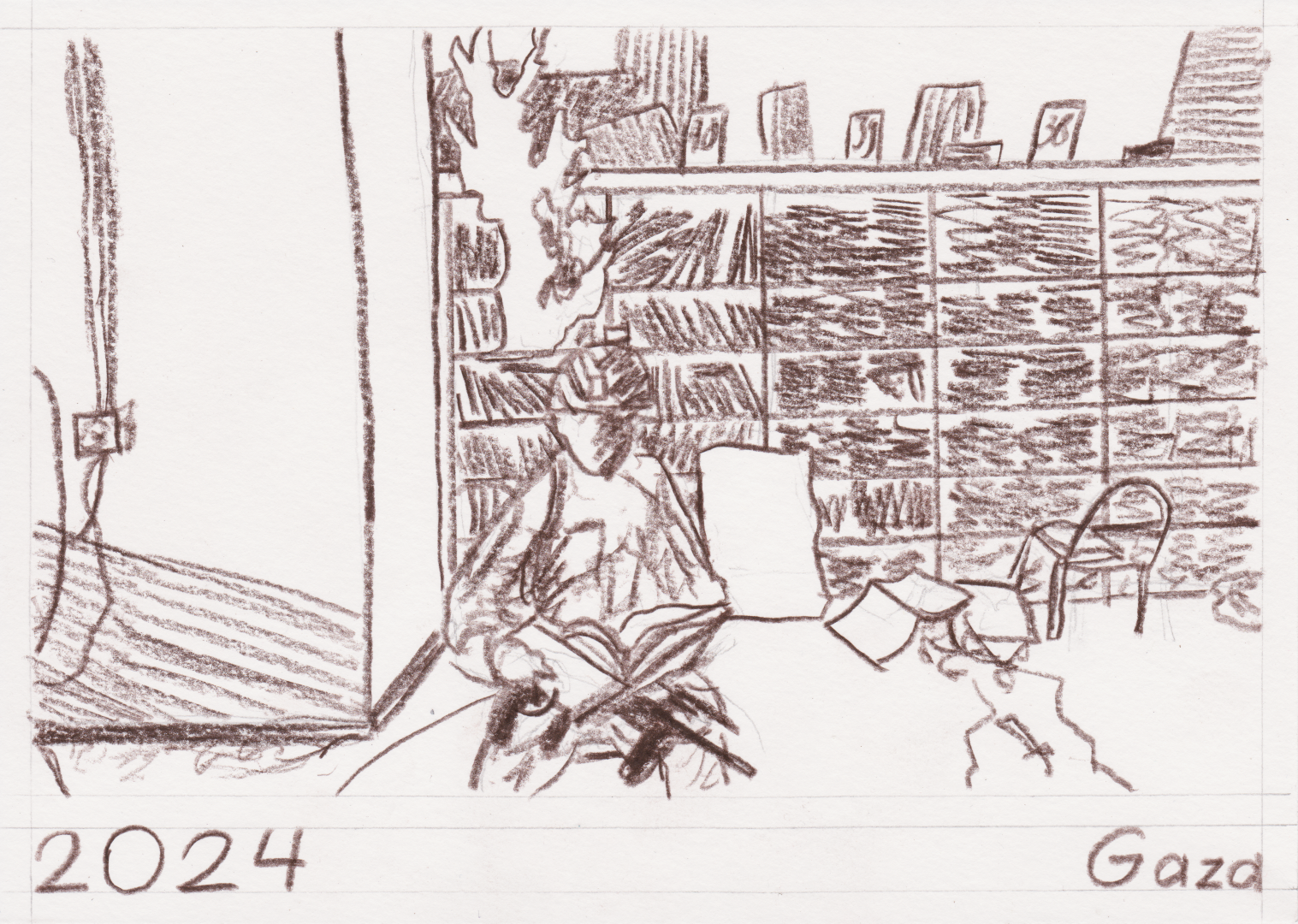
Sodomic Archiving employs the above definitions, in order to shape an archival practice. It means becoming archivists with sexuality, spirit and real bodies. It means thinking about archival practices which threaten the nation-state. In the context of Groningen, I am thinking of the conscientious objectors who worked in the Groningen Archives, placing Anarchist flags, photo-copying their butts and making anarchistic image descriptions. I delight in this brief moment of anarchist subjectivity in the nation-state’s archive. Another case from the Netherlands shows anti-military activists stealing and publishing governmental files on preparations for war. Sodomic Archiving is Anarcho-Sodomic Archiving. It establishes a parasitic relationship to nation-state archives, extracting any useful information and collecting state documents. Because whatever is Sodomic, might burn. I am thinking of the Monsterproces in 1731, with those practicing Sodomy being burned at the stake. I am thinking of the Dutch West-India Company bookkeeper who escaped their Sodomy prosecution in 1730; their son decided to burn the WIC West-India Company archives in 1801. I am thinking of the burning of Sexualwissenschaft documents in 1933 Berlin, the recent deletion of countless American .gov websites and burning down of Palestinian libraries. It has happened before, and it will happen again, that nation-states will destroy complete archives. Without disregarding the urgent and much-appreciated work of queer archiving in nation-state archives, we critically need to think about independence of those archives. Through digitalisation, transcription and translation, access to these files is no longer fully mediated by the nation-state archive. By making physical counter-archives, copy-pasting and adding to the material from nation-state archives, a process of delinking is established. This process, in the long run, aims to establish a relationship of independence and critical distance from stately archives.
Our artistic archival research project of MONSTER ARCHIEF is first and foremost a gesture of salvage and restitution, bringing back the sodomic life that was taken from us. Simultaneously, it is a gesture of barricade and armament, protecting this information from Sodomic history against nation-state fire.
--
With this presentation, I hope to have given you an insight into our Sodomic Archiving at MONSTER ARCHIEF. I would like to end it with a call to connect. Above all, Sodomic Archiving is a concept in formation.
I would like to invite you to think along and to help shape this concept with us. Please reach out if you are interested in doing so, through monsterarchief[at]gmail.com. Thank you for your spacetime and attention.
- (1) The number varies. 21 people were burned at the stake, 1 died during interrogations, and 2 were to be imprisoned for life.
- (2) In the work, I am deeply informed by working with MONSTER ARCHIEF members Siem de Boer, Milly Thee Quing, Chris Luza, Sofía Murillo Lommers, river budur and Tammy Langtry.
- (3) D. J. Noordam, Riskante Relaties, 1995, Uitgeverij Verloren, p. 14 - translation by author
- (4) Henricus Carolinus van Byler, Helsche Boosheit, Sipkes Groningen, 1731, section B - translation by author
- (5) Henricus Carolinus van Byler, Helsche Boosheit, Sipkes Groningen, 1731, section F - translation by author
- (6) Henricus Carolinus van Byler, Helsche Boosheit, Sipkes Groningen, 1731, p. 115-116 - translation by author
- (7) Henricus Carolinus van Byler, Helsche Boosheit, Sipkes Groningen, 1731, Section D - translation by author
- (8) Henricus Carolinus van Byler, Helsche Boosheit, Sipkes Groningen, 1731, Section D - translation by author
- (9) Henricus Carolinus van Byler, Helsche Boosheit, Sipkes Groningen, 1731, section V - translation by author
- (10) Henricus Carolinus van Byler, Helsche Boosheit, Sipkes Groningen, 1731, p. 115-116 - translation by author
- (11) Various authors, Criminele Proceduiren…, 1731 - translation by author
- (12) Henricus Carolinus van Byler, Helsche Boosheit, Sipkes Groningen, 1731, Section E - translation by author
- (13) Henricus Carolinus van Byler, Helsche Boosheit, Sipkes Groningen, 1731, p. 146 - translation by author
- (14) D. J. Noordam, Riskante Relaties, 1995, Uitgeverij Verloren, p. 43 - translation by author
- (15) Jonas Roelens, ‘Those rascals chased from Holland!’ Sodomy, migration and identity building in eighteenth-century Antwerp, in Cultural and Social History, 18(2), 2021, p 183–200
- (16) In the Netherlands, this movement is symbolized by the murdered politician Pim Fortuyn.
- (17) Suhaiymah Manzoor-Khan, Tangled in Terror: Uprooting Islamophobia, Pluto Books, 2022